Showing posts with label beautiful. Show all posts

Tuesday, July 26, 2011

Garuda Wisnu Kencana


Garuda Wisnu Kencana Cultural Park (English: Garuda Wisnu Kencana Cultural Park), abbreviated GWK, is a tourist park on the southern island of Bali. Tourist park is located at Tanjung Nusa Dua, Badung regency, about 40 kilometers south of Denpasar, the provincial capital of Bali. In the garden area of this culture, is planned to set up a landmark or a mascot of Bali, which is a giant-sized statue of the god Vishnu who was riding his mount, Garuda, as high as 12 meters.

Area Garuda Wisnu Kencana Cultural Park located at an altitude of 146 meters above the ground surface or 263 feet above sea level.

In that area there is also the Statue of Garuda Wisnu just behind the Plaza is the Garuda Plaza where the statue of Garuda placed as high as 18 meters while. At present, Garuda Plaza became the focal point of a large hall carved limestone pillars which includes more than 4000 square meters of open space that is Lotus Pond. Limestone pillars colossal and monumental sculptures Lotus Pond, Garuda make a very exotic space. With a capacity room that can accommodate up to 7000 people, Lotus Pond have earned a good reputation as the perfect place to hold major international events.

There is also a statue of Vishnu's hand, which is part of the statue of the god Vishnu. This is one step closer to completing a full statue of Garuda Wisnu Kencana. This work was placed temporarily in the area Tirta Agung.


GWK has several recreational areas including:

WISNU PLAZA

Wisnu Plaza is the highest land in the area where our place while GWK is the most important part of the statue of Garuda Wisnu Kencana statue of Vishnu.

At a certain time today, there will be some traditional performance with a magnificent statue of Vishnu Bali as a backdrop. Because the location is high, you can see the panoramic surroundings. Statue of Wisnu, as the focal point of Vishnu Plaza, surrounded by fountains and water wells in the nearby holy that he never dry even during the dry season.

Giri Somaka Parahyangan placed next to a statue of Wishnu. This place was water, which historically have been trusted by the people in the area as a blessing with a strong magical powers to cure illness and asked the gods of rain during the dry season. Because of its location on high ground (on the hill), this natural phenomenon is considered a holy man and was locally believed to be holy water.

STREET THEATER

Street Theater is the starting point and final visit to Garuda Wisnu Kencana Cultural Park. Here we can find many shops and restaurants in one place and where all the celebrations going on.

You can get souvenirs and merchandise Bali GWK GWK especially in Bali Souvenir Shop and Art Market. We can even find a Balinese spa and aromatherapy products in this store. While here, why not try the foot reflexology Bali after a walk. We can taste good food at the best price only in our food court, Food Theatre, and our newest restaurant, The Home with a package of all you can eat.

At several times a day, we can enjoy shopping and dining while accompanied by the performance of Bali especially like barong, Rindik and parades.

LOTUS POND

Lotus Pond is the largest outdoor area at the Garuda Wisnu Kencana (GWK) and Cultural Park, most likely, in Bali. Thus, the Lotus Pond is a great place and just to hold large-scale outdoor events.

Over the years, GWK has been trusted for large scale was held, both nationally and internationally, the show at the Lotus Pond, like music concerts, international meetings, large parties. Lotus Pond is a unique place with limestone pillars at the sides and the majestic statue of Garuda in the background.

Lotus Pond lotus begins. Lotus is the main symbol of beauty, prosperity, and fertility. Vishnu is also always carry a lotus in her hand and almost all the gods of the Hindu god who sits in the lotus or bring flowers.

Some interesting facts is that the lotus plant grows in water, has its roots in the illus or mud, and spreading flowers in the air above. Thus, the lotus symbolizes human life and also that the cosmos.

Lotus root deep in mud is the material life. Shaft passing through the water symbolizes the existence of the astral world. Flowers floating on the water and open to the sky is emblematical spiritual being.

INDRALOKA GARDEN

This park is named after the heavenly god Indra Indraloka because of the beautiful panoramic view. Indraloka Garden is one of the most favorite place in the Garuda Wisnu Kencana medium for a little party, gathering and wedding ceremonies. We can see the view from the top Indraloka Bali Garden

AMPHITHEATER

Amphitheatre is an outdoor place for special performances by well-designed acoustics. Every afternoon you can watch the famous Kecak dance and free which is about 18.30 s / d 19:30 AM. Even Kecak dance can be collaborated with other regions.

TIRTA AGUNG

Tirta Agung is the perfect outdoor space for the intermediate event. You can also visit the statue of Vishnu's hand, part of the statue of Garuda Wisnu Kencana is located nearby.


Friday, January 22, 2010

Sightseeing Hindu Religion - Buddhism - Confucianism

As a recognized religion in the country, many Hindu and Buddhist heritage yangs enantiasa diziarahi people. The existence of the Prambanan Temple and the temple Brorobudur not just a place of pilgrimage for the Hindu - Buddhist, but has become an international tourist attraction. Even so the existence of pagoda. Building a culture that is this Thionghoa cultural heritage, other than as a place of prayer congregation Confucianism, also excellent emnajdi for religious tourism. Here are some religious attractions Hinduism, Buddhism and Confucianism.

Prambanan
This is the largest Hindu temple complex in Indonesia. Prambanan is located in the village whose territory is divided between the district of Sleman (Yogyakarta) and Klaten (Central Java about 20 km east of Yogyakarta temple that was built around 850 AD This is the Sanjaya Dynasty relics. With the main buildings as high as 47 meters, Prambanan is the largest Hindu temple in Southeast Asia. Since 1991 the temple has become a world heritage site protected by UNESCO, which means that the complex is shielded and has a special status, for example in war situations.


This temple complex consists of 8 major temple or temples and more than 250 small temples. Three main temples called Trisakti and dedicated to Sang Hyang Trimurti: Shiva the Destroyer Batara, Batara Vishnu the Preserver and Batara Brahma the Creator.

Candi Borobudur
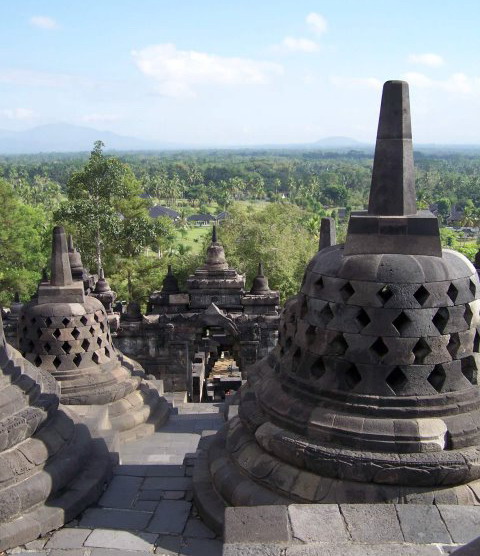
Temple is located in Magelang District, Central Java, this is one of the wonders of the world. Unlike the temples in Bali is mostly Hindu cultural heritage, Borobudur is the largest Buddhist cultural heritage in the world. According to Prof Dr JG Casparis, a ninth-century inscription reveals the genealogy of the three Sailendra king, a king Indra, his son, Samaratungga, and then daughter Samaratungga, namely Pramodawardhani.


In the reign of King Samaratungga, start construction of the temple named Bhumisam Bharabudhara, which can be interpreted as "Hill Improvement Virtue", that is, after over ten levels of Bodhisattva. Having completed for about 150 years, Borobudur is a magnificent pilgrimage center for Buddhists until around the year 930 AD

Grandeur, majesty, beauty, and unique architecture of Borobudur Temple wrapped with important values of the religion, culture and history has been the focus of attention Buddhists. Both in Indonesia and abroad, and tourists in general to come visit.

Sam Po Kong temple
Building stones of Sam Po Kong is a petilasan, the former stops and the first landing of an admiral named Zheng He of China / Cheng Ho or more commonly known as Sam Po Tay Djien. The building is located in Simongan area, southwest of Semarang City is known for its stone building is a huge Batu Caves are situated on a hill of stone.


Now the place is used as the location of the warning and a place of worship or prayer and a place for pilgrimage. For this purpose, in a cave of stone was placed an altar, and statues of Sam Po Tay Djien. They adore Sam Po Kong as a person worthy of respect and uphold and sought his blessing.

Tang Jin De Yuan

From dozens of temples in Jakarta, there are several famous old temples. One of them is the Temple of Jin De Yuan (Kim Tek le) in the area of Old Chinatown Glodok, West Jakarta. This temple was formerly under the management of Guan Gong or the Board of Officers Tionghoa "Batavia, while still berjayanya these institutions, along with Da Bo Gong Temple - Ancol, Tanjung temple (already destroyed) and the Temple of Wan Ji Sie (Kiap Wan Si) in Jalan Lautze . The four temples are known as the "Four Great Temple".


In his book HistoricalSitesofJakarta (1989), Adolf Heuken stated that the "Historical Notes on Brick Tionghoa ~ he" was recorded in about 1 650 Tionghoa Luitenant Xun Guo Guan (Hoen Kwee) established a temple in honor of Guan Yin (Guan Yin) in Glodok. At first, this temple is called Ting Guan Yin (Guan Yin Teng), or literally, Guan Yin Pavilion.

In its development nearly a century later the temple was destroyed and burned in the incident Angke Tragedy Massacre in 1740. In the year 1 755 a renaming Tionghoa Captain who had destroyed the temple and then restored again with the name of Jin De Yuan (Kim Tek le) - Temple of the Golden Virtues ".

Da Bo Gong temple

Although the same age as Jin De Yuan temple in Glodok, Da Bo Gong Temple (Temple of Ancol) has a different background. This temple Tionghoa language called Da Bo Gong Miao or Da Bo Gong temple. From Da Bo Gong or Toa Pe Kong (Hokkien pronunciation) appears Indonesian term for deity statues Indonesians, namely `topekong '.

There's something amazing about this temple. Tionghoa people should not bring pork into the temple courtyard. Why? This is linked with his trademark: Ancol temple is a shrine double. In ancient times, people Tionghoa and Muslims both worship the same place. So this place is a temple and at the same Tionghoa shrine for Muslims. Doubles as a shrine temple Ancol, also found in Semarang (Stone Building) and Palembang (Island Drought).

Source: SuaraMerdeka


Skaten - Acculturation of Islamic values with Local Culture


Sekaten-which is usually celebrated by most of the people of Yogyakarta and Surakarta - is a series of celebration activities Birthday of Prophet Muhammad which was held by Ngayogyakarta Sultanate Sultanate Palace, or Kraton Surakarta Kasunanan with government and local communities. Various forms of events and activities held in celebration Sekaten-diverse varieties and colors change over time-from the nature of religious ritual to the local tradition of art appreciation to exhibitions and fairs. Local culture and modern culture as if melted in the same time the momentum sekaten.

To determine the origin of each year sekaten held by two palace, we must menulusurinya from Demak era. This kingdom is the first Islamic kingdom in Java that stood after the Majapahit collapsed in the Saka year 1400 or 1478 AD. Commemorated by the collapse of Majapahit candrasengkala "Sirna Kertaning Missing Earth". The end of the Majapahit Empire also means ending the Hindu kingdom in Java, under the reign of King Brawijaya V. The first king of Demak was the title of Raden Patah Sultan Petty Officer.

As the King of Islam, Raden Patah always working to advance the Islamic religion tersiarnya throughout the kingdom. Sultan NCO is always thinking about how to the Islamic religion can shine all over the country, and how the people who have embraced the Hindu religion it would insyaf and believe the truth of Islamic teachings.


For the sake of these ideals, Raden Patah finally held a meeting with the trustees of nine, among them the Sunan Ampel, Sunan Gresik, Sunan Giri, Sunan Bonang, Sunan Kudus, Sunan Muria, Sunan Kalijaga, Sunan Drajat, and Sunan Gunung Jati. The meeting discussed ways to broadcast Islam in Java. Sunan Kalijaga broadcasters have suggestions about Islam to be accepted by the society since ancient Hinduism. Sunan Kalijaga proposal is to allow permanent implementation of custom or procedure in the Hindu religion, but it entered the Islamic subjects, such as:

1) Semedi
Meditation in the Hindu religion has a purpose to worship the gods. Because Islam does not
recognize the gods, then replaced with the worship of Allah SWT with prayer.

2) Offerings
Offerings according to the Hindu religion has a purpose to give food to the gods and demons,
to conform with Islamic teachings replaced by nature due to the poor.

3) Crowds
In the Hindu religion has a purpose of saluting the crowd to the gods, saluting the crowd
substituted-day Islamic holiday.

Because people like the Javanese gamelan, and the Islamic feast day of the birth of the Prophet Muhammad, the mosque should also be held in gamelan percussion, so that people interested. If you've assembled and then given a lesson about Islam. And for this purpose, the trustees created a set of gamelan Kyai called Sekati.

The proposal from Sunan Kalijaga, agreed by the other guardians and Raden Patah, the day of birth of the Prophet Mohammed, 12 Mulud gamelan in the mosque was hit. On 12 Mulud than a day of Prophet Muhammad's birth is also the day he died. Apparently a lot of people who flocked to the mosque to listen to the sound of the gamelan. People are coming to mosques despite his distant, so they spent the night in the square or around the mosque.

On the birthday of the Prophet Muhammad, in addition to the people, the regents also came to the coastal city of the kingdom to give worship to the king. They came a few days before the date Mulud and made 12 houses in the square for the night. Regent to the king and then led the king to the mosque. Since the number of people who led the king, comes the word "Garebeg" which comes from the word "anggrubyung" which means lead.

The people who came in the courtyard of the mosque were told to listen to speeches about the teachings of Islam that is easy-easy first. First they were told that is the creed and how it goes. That arise from sekaten word that comes from the Arabic "syahadatain". Credal sentence is a sentence that should be read by anyone to convert to Islam, which has a meaning: there is no god but Allah and Muhammad is the messenger of God. Creed sentence was also written on the gate of the mosque. Because many people came flocking to the mosque and many are overnight, so many people are selling at around the mosque and the square.

Sekaten than syahadatain derived from the word, also derived from the word:

1) Sahutain
To stop or prevent the case two, the nature of the prostitute and perverted.

2) Sakhatain
Eliminate the case of two, namely the character of animals and nature of the character of
satan as the source of damage.

3) Sakhotain
Menamankan case two, always to maintain the holy mind or mind sublime and always thrall
to God.

4) Sekati
Equilibrium, the living must be weighed or judge things good and bad.

5) Screen
Borders, the living must limit themselves to not do evil, and know the limits of good and evil.

Sekaten tradition that is celebrated to commemorate the birthday of Prophet Muhammad is still preserved by the kings who ordered subsequent to the time of Mataram. At the time of the Mataram kingdom until it moved to Surakarta and Yogyakarta, sekaten held for political purposes, namely to know the loyalty of the regents of the region of the kingdom. In celebration of the regents sekaten must come to offer tribute and to offer worship, devotion to the king. If the magistrate is unable to attend, it must be represented by the kingdom. This was done because if the magistrate was not present at the celebration sekaten interpreted as a form of defiance against the king.

Sekaten celebration held by the kingdom of Mataram, but aims to commemorate the birth of Prophet Muhammad also to show that the king who ruled there was a relationship with the Prophet Muhammad, the messenger of God. Sekaten also has political and economic roles. Because the sekaten, the regents must give tribute sowan and sekaten presence in the ceremony as a sign of loyalty to the king who ruled.

With the times, sekaten also used in the trade sector. Sekaten celebration as a community farm to trade and create a vivid celebration of the sekaten. In addition to listening to the gamelan, the visitors can buy a variety of traditional foods sekaten, as well as children's toys.

From here, can we conclude that looked Sekaten not only in the frame as such a religious perspective or the lens of local culture-the culture of Java - alone. Such perspective would lead to distortions that tend to raise the debate that never ends. The debate will lead to the problem of interpretation of religion - the normative and historical dimensions as well as Islamic and das sein das sollen - and lead to division and disagreement if the difference is not framed in an effort to obtain and strengthen the fabric of "ukhuwah" Islamiyah, Wathoniyah , and Basyariah.


Tuesday, January 19, 2010

Studio 76, Silver Jewellery Making Course


Travelling in Yogyakarta won't be complete enough without visiting Kotagede, the silver center in the city. It's not just to buy silver jewellery, it's more fun cos you're gonna make the jewellery by yourself. Guided by professional instructors, it only takes 3 hours for you to make rings, earrings, pendants etc... The perfect souvenir of Kotagede originally made by yourself!

Studio 76 is house of art producing silver handicrafts such as evening bag, miniatures of horse cart, tricycle, royal carriage, etc. Apart from producing those handicrafts, we also arrange short courses to make jewellery. This programme is specially designed for tourist to make their original Kotagede's souvenir.

With more than 6 years teaching experience, we believe that we can make you proud, satisfied, and impressed with your own jewellery as the result of your course in Studio 76.

Studio 76 is located in the middle of Kotagede. You will find the real atmosphere of Kotagede. Their typical life, the silversmiths, the traditional food, and the ancient buildings.

The following courses packages are adjustable to your holiday schedule in Yogyakarta.

Short Course
The duration of this short course is 3 - 4 hours. Under guidance of professional instructors, you will be able to make ring, earrings, or pendant in that short period. The participants will have to do all the processes from designing, forging, carving, soldering, polishing and so on. The instructors will only show, control, and fix to make better items. By the end of the course, the participants will be proud of their product and do not believe that they just made the jewellery by themselves.

Time:
Three different choices every day
09.00 a.m. - 12.00 p.m.
01.00 p.m. - 04.00 p.m.
05.00 p.m. - 08.00 p.m.

Facilities:
Historical silversmithing explanation
3 hours of instruction (Indonesian, English, and France speaking teacher)
Your personally created silver jewellery (5 grams maximum)

Cost:
IDR 150,000 / pax (1 person)
IDR 125,000 / pax (2 - 3 persons)
IDR 100,000 / pax (4 - 6 persons)

Note:
For an effective class, maximum six persons per session.

Full-day Course
With more time and more materials, you should make prettier silver jewellery. Besides, many of the participants of the short course get back and join this session in order to make better items than their first course.

Time: 09.00 a.m. - 04.00 p.m. (With 1-hour luncheon break)

Facilities:
Historical silversmithing explanation
7 hours of instruction (Indonesian, English, and France speaking teacher)
Your personally created silver jewellery (10 grams maximum)
Lunch with local menu

Cost:
Rp. 250,000 / pax (1 person)
Rp. 225,000 / pax (2 - 3 persons)
Rp. 200,000 / pax (4 - 6 persons)

Note:
For an effective class, maximum six persons per session.

Weekend Course
We arrange this package for those who cannot come to Yogyakarta. As it is implied by the name, this course is arranged on Saturdays and Sundays from 09.00 a.m. To 04.00 p.m. With one hour luncheon break. This package includes the basic tools to make silver jewellery and after the course, the participants are expected to be able to create their own products by themselves using the provided tools.

Time:
Saturday and Sunday, from 09.00 a.m. - 04.00 p.m. (1-hour lunch break)

Facilities:
Explanation on the technique of silver handicrafts
Basic tools to make silver handicrafts
Module of silver handicrafts basic course
Instructors (Indonesian, English, or France language)
The course products of 20 grams at maximum

Cost:
IDR 2,500,000 for 2 persons
Extra cost of IDR 1,000,000 / person for additional participants
It includes cost of transportation for the instructor (big cities in Java)

Note:
For an effective class, maximum six persons per session.

Arranged Course
This course is suited to the target, time and the needs of the participants.

Please make your reservation in advance!!
For reservation and information, please call AGUS at +62 81 2278 2279


STUDIO 76
Jl. Purbayan KG 3 / 1190 Kotagede Yogyakarta
Phone: +62 274 7147676
Fax: +62 8122782279
Contact Person:
Agus: +62 8122782279

source : yogyayes

Batik Course - Hand-made Batik to Batik Painting


Visiting Yogyakarta, you may not just buy and enjoy the marvelous batik artwork, but you have the opportunity to learn the technique of its production. The valuable opportunity packed in an interesting tour package with quite short duration and affordable cost will surely be fun.

Batik patterns you can learn involve hand-made batik, printed batik and painted batik. Each place usually has its special batik pattern to teach. For one day course, it is usually divided into two sessions; you will learn all processes of batik making that generally consist of pattern making, cloth coloring, wax dying and drying.

The process of pattern making starts when all materials, especially the cloth are ready. The making of this pattern is done with wax as the main material that is used to block color. If you want to make hand-made batik, the pattern making is done by using the wax pen called canting while printed batik is made by utilizing a prepared copper stamp with certain design.


You are free to choose the pattern you are going to make. Unique patterns you can make are, for example, ceplok, cecek sawut, and semen. You can find all of the patterns in historical buildings in Indonesia. Ceplok pattern can be found in Borobudur Temple; cecek sawut in a copper drum in Copper Time while semen pattern can be found in the tomb of Kalinyamat Queen.

The process is continued by coloring the cloth. The cloth with pattern on it is dipped into a bucket filled with coloring agent. This process seems simple, but actually it is difficult, moreover if batik must be colored more than two. Many batik artisans still use natural colors made from certain natural materials, but there are many who use synthetic coloring agents.

After coloring thoroughly, the process is continued by dying the wax, or removing the wax attaching to the cloth. Initially, prepare the boiling water mixed with soda ash and finally the cloth is dipped to remove the entire wax. If there is still wax attached, it must be cleaned after the dying process.

The final step is washing. When using natural coloring agent, the washing cannot be done by using detergent that will damage the color. After being washed, the cloth is dried under indirect sun to avoid discoloring. After this drying process, you can see the difference of batik colored with natural coloring agent; the color is usually less bright.

Batik courses in Yogyakarta provide professional instructors to make you competent even though with short course only. Some places also have instructors speaking foreign languages, especially English, to ease you understand the lesson.

One of the places providing batik course is Sanggar Kalpika in Kampung Taman, at the west of Tamansari. There, you can learn painted batik. If you prefer to learn hand-made and printed batik, Balai Batik is the right place. The institution that is located on Jalan Kusumanegara provides special staff and room for you to learn batik. The cost ranges from IDR 250,000 to IDR 1,500,000 based on the course types.

In addition to learning batik, you can also enjoy the activity and the works of batik artisans in Kampung Taman that 30 years ago has been developing painted batik. You can also see various batik styles exhibited in Balai Batik.

source : yogyayes

Eating Turi Flower Pecel by Mbah Warno "Anderson"


At first, I was confused by the name of Baywatch pecel owned by Mbah Warno eatery. Passing in my mind, a naughty imagination of a naughty waitress wearing bikini like what Pamela Anderson wore on Baywatch serials or at least it's located on seashore area.

Mbah Warno eatery is located at Kasongan, at the street heading to Sempu Mountain. This place was established 35 years ago and it has a very simple interior. The banner has 30 cm long and 20 cm width which can be easily skipped for those who don't pay attention to it. The interior is totally equipped by simple functional equipments. Only tables and wooden chairs. Behind the table, there're some braziers which always produce smokes. A peculiar position which accidentally designed like that because kitchen in javanese concept is always put at the back of the house but Mbah Warno put his kitchen in front of his eatery after the earthquake accident and he simply said due to the financial constraint he did it.

Mbah Warno serves main menu which is pecel accompanied by some meals starting from fried ell, bacem tofu, lele and mangut ell (ell with coconut milk and chili) and fried noodles. Yogyes ordered everything to taste all Mbah warno culinaries.


During the time of waiting, my mind flew to track down the origin of pecel which is as little known as soto. Many regions in Java have their own pecel with their own characteristic such as Madiun, Blitar, Madura, Slawi and etc. But for at least, a dutch historian enlighted with the fact when Ki Ageng Pamenahan undertook Sultan Hadiwijaya's instruction to proceed to a jungle named Alas Mentaok (now, Kota gede), his groups were welcomed by the opak river-side inhabitants and then they're given some foods including pecel.

My reverie was suddenly cut by the arrival of my pecel and some other meals on the table. A portion of pecel, fried lele and bacem tofu somehow challenged me to eat them as soon as possible. There are four kinds of vegetables which are spinach, papaya leaves, Turi flower (Sesbania grandiflora) and poured by nut sauce which is so yummy. We’ll have sweet flavor from nut sauce and bitter flavor from Turi flower making an unexplainable delicious mixture.

Pecel with Turi flower is the symbol of Ndeso pecel. In this age, it's hardly ever seen a pecel seller packages a kind of it. It's deemed that Turi flower has the benefits of alleviating high body temperature and headache. No wonder, some javanese, indian and Suriname (their ancestor is still javanese though, LOL) still consume young Turi flower as their vegetable.

Pecel will be more delicious by adding with fried lele or Bacem tofu. This lele is fried until very dry so that it's really crispy when you have a bite. And bacem tofu is quite big so you can eat it by combining with some small chilies. Apart from it, you can also have fried ell that has two different sizes and also you can have fried noodles and mangut ell for those who think that spicy is the best one. Smoke from brazier also adds more sensation to this place.

I don't know whether it's caused by my full stomach or effect of Turi flower, after eating, my head was way much smartier than usual. During the small conversation with Mbah Wartno and his assistant, i suddenly understood why pecel at this place is called Baywatch pecel. Apparently, Mbah Warno and his assistants always wear clothes called Kutang. These clothes are really comfortable to wear in the hot and dry weather of Kasongan village, Bantul.

Even though, many people sell pecel everywhere, Baywatch pecel still offers something new for you. A great combination of delish foods, strong village ambiance and hospitality of Mbah Warno "Anderson".

Taman Sari Palace Yogyakarta (Indonesia)


This park was built by Sultan Hamengkubuwono I in 1757. He created a new architectural style is a mixture of Javanese and Portuguese style. At first Taman Sari is a beautiful water garden and charming. The area east of the park up to the crossroads town called Suryoputran. Segaran in Javanese means of artificial sea. Every time the Emperor visited the park, he would row his own boat across the suspension bridge is called 'Kreteg Hanged' is located in front of the gates of the Palace, to the south or north Kemandungan. Another part of the building that used to connect to the suspension bridge can still be seen.

Apart from water transport, there is also an underground road or tunnel from the Sultan's Palace that led to one of the buildings in the park called Ledok Pasarean Sari, which is where the clash and the Emperor's personal. Well there is also Gumuling, ie, two-story building with a floor underneath lies below ground. In the past, this building is a kind of where the Sultan surau Prayer worship that can be achieved through one of the underground tunnel in the park complex. In addition, there are still many underground passageway, which was once used as a way of saving at any time when this complex enemy attack. To the north lies the complex essence Park Ngasem market (bird market), where this place sold various types of animals and birds.

Formerly Water Palace is not just a beautiful park but also used for shelter. When the enemy attacked the Palace, the Sultan and his family escaped through an underground road. By the time they were in a safe condition, the floodgates will be opened so that water would be running down the street and drown the enemies in pursuit.


In one part there is a section called Pulau Kenanga because in the courtyard Kenanga trees grow (Canangium Odoratum. Bunga Kenanga fragrant smell spread throughout the park.

Tall buildings such as the pool was built specifically for use by the Sultan and his family to bathe. The buildings have been renovated including the underground path to the west, the fortress that surrounds the Palace and the southbound direction of a small village called Krapyak.

Besides enjoying the ancient buildings, tourists can also visit the many shops and art galleries along the alley / lane. Batik can be found easily in shops and galleries are. Once this area is a place for artists Palace.

Now, Castle visited by many tourists, who can enjoy the beauty of the park from 08.00 to 16.00 WIB.

Location: Jogja
Transportation: - Bus Route 9 lines, 12 and 15 - Personal Vehicle

Yogyakarta Palace (Indonesia)


More than 200 years ago, the place where the Sultan's Palace are now in a marshy area known as Pachetokan Bannerman, who later built a rest house named Ayodya. Sultan's Palace facing the north, on the north south axis, between the mountains and the sea south trim. In the palace hall, the scene can be witnessed pisowanan (supreme court) where the Sultan sat on the throne stakeholders faced court office.

Donopratomo Regol Sri connecting pages with the page core Manganti palace, guarded by 2 (two) sculpture named Dwarapala Cingkarabala and Balaupata, which represents both the human personality, who always uses her voice to always do good and forbid evil. At the core of the palace yard, can be seen where the Sultan lived used to receive guests of honor and a party. In this place there is also a place to stay keputren or daughters who had married the Sultan. Yogyakarta palace complex can be visited by the general public from 07.30 until 13:00 every day. Certain days, closing on Friday and open until 12:00 o'clock.

Glagah Beach Kulon Progo (Indonesia)


Glagah beach is located about 40 km southwest of Yogyakarta in Kulon Progo district. Serang River which flows into the estuary to the sea south of this beach. On all sides of the river is shaded green and overgrown with palm trees. This place is ideal for camping or just relaxing. The local government has built this beach area with various recreational facilities such as parks, swimming and fishing camp. Before reaching the beach there Serang river, where sports fans can meperoleh rowing facilities (canou). Glagah beach is about 1.5 kilometers from the coast Congot, Kulon Progo Regency, which both have been associated with a paved road. Sightseeing Glagah beach attraction is a big wave, a long coastline, cool air and clean water. Advantage of this tourist attraction is the presence of Serang river which empties into the beach Glagah that can be used for tourism tirta. This activity is carried out in Serang river. Visitors who already use the river Attack tirta tourism activities, mostly tourists, nature lovers, especially students from universities in Yogyakarta.

In addition tirta tours, special interest tourism activities undertaken is a form of sporting event. Event ever held at the Beach is a championship motocross Glagah to the regional level. This event is able to attract visitors, both as participants and as spectators. Planned motocross championship held every year fighting the rotating trophy Regent Kulon Progo. Another event held in Glagah Beach is a national championship beach volleyball in 1997.


Glagah beach also has the attraction of cultural tourism, which Merti ceremonial village. This ceremony is performed for the safety of villagers Glagah. The activities of the local arts performances such as puppets and Jatilan. In addition to the Village Merti ceremony, the beach is also used to Glagah Labuhan ceremony of Breeds Mangkunegaran.

Location: Kulon Progo
Transportation: Bus Yogyakarta-Purworejo

Batik Craft Yogyakarta (Indonesia)


Batik is a unique work of art. A combination of artistic expression with technical skills that exist only in Indonesia. By using wax and dye materials dyed, batik is made on a piece of cloth. As well as the other predicate, Yogyakarta is also known as the city of batik.

Based on the technique used, divided into Ketegori batik: batik, batik print and a combination of both. Working with batik tool called "canting" made of brass or copper with varying motives, whereas the combination of batik is batik canting resulting from the combination and mold. Batik quality is determined by the level of difficulty motives, techniques and materials manufacturing base fabrics. At first the colors and motifs were very influential in nature, especially flowers and plants such as jasmine, mythical animals such as bird Garuda. The dominant colors used are blue or black, is a symbol of water and air. The colors are then to be two basic elements. Symbolically, the two colors into the background of traditional batik designs in Yogyakarta and Surakarta.

Location: Province of DIY

Goa Cerme (Bantul)


Goa Cerme at first was a meeting place used by Walisongo to spread Islam in Java. The word 'Cerme' comes from the word 'speech', held talks during the meeting discussed a plan to establish in the Great Mosque in Demak, a city north of Central Java.
The average depth of water flow of about 1 m, ends at the village exit gate Ploso, Giritirto, Bake, Gunung Kidul Regency.

In addition to the main cave is another cave in which the smaller was used for the meditation cavernous puppeteer. Goa Ledhek, Badhut cave, and caves People. On Monday or Tuesday wage pengunjng many have come to ask God's blessings with thanksgiving ceremonies. During the holidays, many students and young people visiting this temapat. Along the corridor in a cave there is a stage Cerme which was used for the rendezvous.

To reach the front gate of the cave, one must climb the stairs 759 meters. It's better if visitors contact Interpreter Lock or guardian first cave to get the information or correct information.

These include caves Goa a long and deep. The entrance was in the village Selopamioro, kecamatam Imogiri, Bantul regency, while the exit was in Ploso village, subdistrict Bake, Gunung Kidul district. Total length of cave approximately 1.5 km.

Way to achieve this very good location and distance of about 20 km. The view towards the village of Goa last Cerme very good. In the daytime, when the weather sunny, the city of Yogyakarta looks beautiful and at night could see the lights of the city.

Conditions in the cave without lights (flashlight) / dark and cave floor flooded by ground water, which in the rainy season the water will put (up), but in the dry season the water subsided (down). Can also be found Stalactite and stalagmites are very good, too many bats. In general, foreign tourists who visited the cave Cerme spent between 3 to 5 hours on location.

Friday, January 2, 2009

Lampung

Lampung province is located at the extreme of south of Sumatra is overlooked, over flown by most tourists. In the past it was well known for its marvelous 'tapi' fabrics, some using real gold thread, and for its pepper. But today, it is the location from ambitious transmigration projects, resettling farmers from over-populated Java. It boasts volcanoes, wildlife reserve, megalithic remain and a superb coastline of deep-cut bays and wonderful beaches. Its capital is Bandar Lampung, is made up of twin cities that is Teluk Betung and Tanjung Karang. Way Kambas Nature Reserve is a 130,000 ha area of swamp and lowland forest with wild elephant, tapir and many other animals.

The name of Lampung province was taken from origin Lampungnese. Before Indonesia became independent country, a resident led Lampung region and the status was as residency area (Residentie lampungche districten) with many afdeling (afdeling Teloek betoeng, afdeling metroand afdeling kotabumi). The villages/old town with traditional living characteristic could be found like sukadana, menggala, kenali, liwa, blambangan umpu etc. A part of these town bacame the capital of district. In the first of 2000 was 7 millions the population of Lampung Province. Among 10 district / town, the most population was in central Lampung with 1.901.630 and the density population was in Bandar Lampung city, 3.763 soul/km2.

Geographically
Lampung province is located between 3o 45' and 6o 45' South Latitude and between 103o 40' and 105o 50' East Longitude. This province is bordered by:
North side: South Sumatra Province
South Side: Sunda Strait
West side: Bengkulu Province
East side: Java Sea

Wide Area
The wide area of Lampung province is 33,307 sq km,
Administrativelly
Lampung Province is divided among 4 regencies, 1 municipality and 1 administrative town with Bandar Lampung as its capital city.

Temperature
The humidity of this province is various between 50% and 86%, and the rainfall is ranges between 2,000 and 4,000 mm per year. The temperature ranges between 20o C and 34o C.

Demography
The migration flow to Lampung province is supported by the existence of heavy plantation, fishery and industry. In 1994, the total population of this province was 6,200,306 people, with its average density of 196.8 people per Km2.
Compared to the average national population growth amounted to 2.144% per year, this province was on the lower level with 2.12% per year during the 1990-1994 period. The projection and composition in 1997 can be seen on the following table.

Population
Lampung society consists of two main groups, respectively has special traditional law. They are Peminggir traditional society and Pepadun traditional society. Peminggir societies, such as, Krui, Ranau, Komering, and Kayu Agung society, live along the coast And, Pepadun society, who customarily conservative, such as, Abung (Abung Siwo Migo), Pubian (Pubian Telu Suku), Tulang Bawang (Migo Pak), Buai Lima (Way Kanan), and Sungkay Bunga Mayang, live in the inland.

East Nusa Tenggara

East Nusa Tenggara Islands have been shaped by the power and force of an enormous chain of mountains and volcanoes, which begins from the North of Sumatra and stretches east across Java. The province consists of over 550 islands, but is dominated by the three main islands of Flores, Sumba, and Timor. Occupying a unique position at the junction of Australian and Asian submarine ridges marked by the Wallace Line, it is one the world's most dynamic and exotic marine environments with nearly every species of coral and tropical fish represented. The arid landscape of eastern and southeastern Nusa Tenggara is the result of hot, dry winds blasting in from the Australian continent. In fact, in many coastal areas not a drop of rain falls during most of the year.

Flores is a Portuguese name, which means 'flower' and ideally describes the beauty to be found here. This long island between Sumbawa and Timor is crowded with volcanoes and mountains dividing it into several distinct regions with individual languages and traditions. Predominantly Catholic and heavily influenced by the Portuguese, there are many examples of a strong European cultural heritage like eastern procession held in Larantuka, and the royal regalia of the former king in Maumere.

Formerly known as the Sandalwood Island, Sumba is now famous for its horses and an excellent style of ikat cloth. Spirits, both ancestral and natural are worshipped. Although some exist in East Sumba, it is in West Sumba that there are a number of enormous megalithic tombs and traditional thatched and peaked huts raised on stilts. It is here where incredible rituals take place, such as 'Pasola' where hundreds of horsemen fling spreads at each other in an annual ritual. Many traditional ceremonies, all with a component paying homage to the spirits, take place from July to October including the traditional houses and burials when sometimes hundreds of pigs, water buffaloes, horses, and dogs are scarified. Other ceremonies include 'Pajura' or traditional boxing, festivals for the Lunar New Year in October and November, horse races and ritual dances.


GEOGRAPHICALLY
East Nusa Tenggara is one of the four provinces in the Nusa Tenggara (Southeast Islands). Starting from Bali, West Nusa Tenggara, East Nusa Tenggara, and east Timor. It stretch is between 118° and 125° east longitude, and between 1 18° and 125°southern latitude lines, and between 8° and 12 ° southern latitude lines. The territory of East Nusa Tenggara Province comprises 566 islands. The three main islands are Flores, Sumba, and Timor from which come the term FLOBAMOR, which has been familiar as one of the names of East Nusa Tenggara.
Flores is the main volcanic island and has many unique and spectacular attractions, one of these is Mount Kelimutu with its lakes of distinct color variation, has become one of the fabled destinations travelers.
Sumba is the island famous for its arts, handicrafts, particularly the textile weaving, and cultural assets. The other name given to East Nusa Tenggara is "Nusa Cendana" the Sandalwood Island.

GEOLOGICALLY
Geologically, East Nusa Tenggara can be regarded as being divided into two zones: first, the volcanic inner curve formed by the islands Rinca, Komodo, Flores, Alor, Pantar, Adonara, Lembata and Solor, which have fertile soils and second, the out curve with limestone and rock formation, made up of the island Sumba, Sabu, Rote, Semau, and Timor.

DEMOGRAPHY
The total number of NTT inhabitants in 2001 was 3,888.735 - 1,919.644 (49.36%) men and 1,969.091 (50.64%) women. The most populated is Manggarai regency (621,989 people) and Kupang city is the most densely populated (1,517.30 people per square kilometer).

CLIMATE
Due to central highlands and their closeness to Australia, the seasons are irregular. Generally the islands are semi-arid, with a longer dry season lasting from March to November. The wet season lasts from December to March, but can be considerably shorter and small island of Savu. The average rainfall of this region is between 36 - 4,127 mm/year. The temperature is range from 20.3 C to 31.7 C.

TOPOGRAPHY
East Nusa Tenggara is mountainous, and very steep slopes are everywhere besides some not too wide plateaus or uplands. The lowlands are a long the coastal areas only. Despite of the situation, most part of this region is not fertile, since the rainfall varies between 500 mm and 2000 mm a year.
East Nusa Tenggara (NTT) is includes 566 islands. In addition, there are 524 uninhabited islands. It covers an area of about 47,349.9 square kilometers, including 200,000 square kilometers of maritime territory. Roughly 57 percent of the territory is hilly, with cliffs. The lowlands lay generally around the beaches and river mouths.

WIDE AREA
The area of East Nusa Tenggara occupies an area of 49,879.98 square kilometers, and has a population of more than 3,500.000. It is divided into 12 regencies and one municipality. Kupang regency is the largest region (7,178.26 square kilometers) and the smallest region is Kupang city (160.34 km2).

LANGUAGES
There are a lot of languages spoken in East Nusa Tenggara coming from as many different which groups of the population. Bahasa Indonesia is the national language in Malay, written in Roman script and based in European orthography. In all tourist destination areas English is the number one foreign language fairly spoken and written.

West Nusa Tenggara

The Wallace Line, named after 19th century naturalist, Alfred Russell Wallace, marks a point of transition between the flora and fauna of Western and Eastern Indonesia and acts as the Western boundary of West Nusa Tenggara, which includes Lombok Island and Sumbawa. Lombok is noticeably different to its close neighbor, Bali. The northern part of the island is mountainous and lush with tall trees and shrubs. The South on the other hand is arid and covered by savannas. Large Asian mammals are absents and replaced instead by large numbers of marsupials, lizards, cockatoos and parrots. The difference becomes more pronounced as one moves further east where dry seasons are more prolonged and the land is dry and bush-like, and so in many areas corn and sago are the staple food, instead of rice. At first Islam time come to these islands in the 16th century, four Hindu Kingdoms co-existed in apparent peace what is now called West Nusa Tenggara and is still the religion embraced by those in the west of Lombok, which are primarily Balinese. Lombok experienced strong Balinese influences in the past, but has still retained a unique identifies. The indigenous people of Lombok, the Sasaks, are predominantly Moslem and have a strong, distinguished tradition, as do the people of neighboring Sumbawa. Soft white sand, virgin beaches are typical in Lombok, where the motto is 'You can see Bali in Lombok, but not Lombok in Bali'. Famous for its 'tenun ikat' hand-woven textiles, the island has exceptional charm and its relatively undiscovered, except for Senggigi City, which becoming a major resort area. Regulars shuttle flights from Bali and Surabaya as well as ferries provide excellent transportation links within the islands of the province as well as with the rest of the country.


The two largest islands in West Nusa Tenggara province are Lombok in the west and the larger Sumbawa Island in the east. Mataram, on Lombok, is the capital and largest city of the province. The province is administratively divided into six regencies and one municipality, Mataram. The Sasak ethnic group mainly inhabits Lombok, with a minority Balinese population then, Sumbawa and Bima ethnic groups inhabit Sumbawa. Each of these groups has a local language associated with it as well. The population of the province is 3.821.134; 71 percent of the population lives in Lombok.

Geographically
Geographically, West Nusa Tenggara Province is located 115'45 - 119°10 east Longitudes 8°5 - 9°5 south latitudes. Its area boundaries is:
North Side: Java Sea
South side: Hindia Ocean
East side: Sepadan Strait
West side: Lombok Strai

Wide Area
The wide area of West Nusa Tenggara is 49.32,19 Km2 that contains of 20.153,07 Km2 land and 29.159,04 Km2 of sea. The two big islands is Lombok Island with its wide area about 4.738,70 Km2 (23,51%) and Sumbawa Island with 15.414,37 Km' (76,49%) wide area. Beside that, it also surrounded by thousands small islands, such as Gili Air, Gili Meno, Gili Trawangan, Gili Gede, Gili Nanggu, Gili Tangkong, Moyo Island, Bungin Island, Satonda Island, Kaung Island, and Panjang Island.

Government Administrative
Administratively, the capital of West Nusa Tenggara is Mataram city and contains of 7 regencies and 2 cities. The four regencies/cities are located in Lombok Island and 5 regencies/cities state in Sumbawa Island.

Bali

Bali Island, the perfect holiday destination for all ages offers something for everyone. Bali offers not just various customs but also various "adrenalin pump" parks. Many exciting amusements are available in Bali, with something new opening all the time. The number of offshore and inland attraction are on the rise because many tourists want them. This tropical paradise has a unique blend of modern tourist facilities combined with wonderful shopping and a rich past and heritage. After white water rafting that has gained popularity in Bali, comes offshore rafting or ocean rafting. The more adventurous sort of amusement has now become an alternative sport for tourists. Meanwhile white water rafting is still a popular activity with trips on Ayung, Telaga Waja, Unda Rivers, etc. The tourists can refresh their mind by watching beautiful scenery along the route. Those are not enough, some of the best surfing beaches in the world can be found on the western side of the island whilst conversely the eastern side is a wonderful haven for families, with beautiful white sand beaches and gentle seas.


Bali is small island, just 140 Km by 80 Km and lies between Java, the most highly populated and influential of all the islands, and Lombok, one of the quieter and moderately slower paced islands. Like many islands, Bali has developed a world of its own. It not only captures what is special about Indonesia but also has a uniqueness of its own.

The culture of Bali is unique. People say that the Balinese people have reached self-content. The Balinese people are proud of having preserved their unique Hindu culture against the advance of Islam, the dominant religion throughout Indonesia. This is still reflected in days to day life and can be seen in the numerous ceremonies, Balinese festivals and magnificent temples and palaces. The Balinese are skilled artisans, particularly in woodcarving and in fashioning objects of tortoiseshell and of gold, silver and other metals. The Balinese are noted for their traditional dance, the distinctive music of the gamelan and for their skills in weaving cloth of gold and silver threads, Songket, as well as for embroidering silk and cotton clothing. Stone and woodcarvings, traditional and modern paintings and intricately designed jewelry in gold and silver are readily available in shops and galleries throughout the island.

As for recreation, there is no shortage of options. Nature walks, horseback riding, diving, surfing - even bungy jumping and white water rafting - await the adventurous here.

Tuesday, November 11, 2008

Prambanan, a Hindu temple in the World


Prambanan is the extraordinary beautiful building that was built in the century to 10 in the governance of two kings, Rakai and Rakai Balitung edges. Soaring up to 47 meters (5 meters higher than the Borobudur Temple), the foundation of this temple has been fulfilling the author, shows the triumph of the Hindu land in Java. This temple is located 17 kilometers from the city center, in the middle of the area that is now built beautiful garden.

There is a legend who always told people about this temple of Java. Almah, the man called the Bandung Bondowoso love Roro Jonggrang. Because I love, Jonggrang create temple ask Daska by 1000 statue in the night. Demand is almost fulfilled before Jonggrang ask villagers pound of rice and create a fire so large as to establish the atmosphere of the morning. Daska can create a new 999 statues and condemn Jonggrang a statue to-1000 due to fraud.

Prambanan temple has 3 main page in the main, the Vishnu Temple, Brahma and Shiva. The third temple is the symbol of the Hindu belief in the Trinity. The third temple is facing east. Each temple has a main temple facing the assistant to the west, namely Nandini to Shiva, Swan to Brahma, Vishnu and for Garuda. In addition, there are 2 temples wedge, 4 temple curtain, and 4 corners of the temple. Meanwhile, the second page has 224 temples.

Entering the Shiva temple located in the middle of the building and the most high, you will find fruit room 4. One room contains the main Shiva statue, while the other 3 rooms each contains a statue Durga (the wife of Shiva), Agastya (teacher Shiva), and Ganesha (son of Shiva). Durga statue that has a statue in the legend Roro Jonggrang told above.

In Vishnu Temple, located in the north Shiva temple, you will only see one room contains a statue of Vishnu. Similarly Brahma Temple, located in the south of Shiva Temple, you will also find only one room contains a statue Brahma.

Temple assistant who is quite enchanting Candi Garuda, which is located near the temple, Vishnu. Temple save this story about the human figure half a bird named Garuda. Garuda is a mystical bird in Hindu mythology who have a body of gold, a certain kind of face white, red-winged, beaked and winged like a hawk. It is estimated, the figure is the adaptation of the Hindu figure Bennu (meaning 'rising' or 'shining', usually associated with the Gods Re) in the mythology of Ancient Egypt or Phoenix in the Ancient Greek mythology. Garuda can save his mother from the curse of Aruna (sister of Garuda, which was born with disabilities) to steal Amerta Tirta (holy water of the deity).

The ability to save that admired by many people until now and is used for various purposes. Indonesia to use the symbol of the country. Come, creator symbol of Garuda Pancasila, seeking inspiration in this temple. Other countries that also use it to the country is the symbol of Thailand, with the same reasons, but the adoption of performance and different. In Thailand, Garuda is known by the term Krut or Pha Krut.

Prambanan temple also has a relief that the story of Ramayana. According to experts, the relief is similar to the story of Ramayana derived through oral tradition. Relief that is interesting is the Kalpataru tree in the Hindu religion is considered as the tree of life, environmental sustainability and harmony. In Prambanan, a relief described Kalpataru trees flank the middle of the lion. The existence of this tree to make experts consider that the century-9 to have wisdom in managing the environment.

Same as figure of Garuda, Kalpataru is now also used for various purposes. In Indonesia, Kalpataru become the symbol W Environment (WALHI). In fact, some scientists in Bali to develop the concept of Tri Hita Karana for the preservation of the environment with a view Kalpataru relief in this temple. The tree of life that can also be found on the gunungan used to open the puppet arts. A proof that the relief that there has been foremost in Prambanan.

If careful, you can also see various birds, relief, this time a real bird. Reliefs of birds in the Prambanan Temple, so naturally, so the biologist can even identify them until the level of genus. One relief Cockatoo Yellow plume (Cacatua sulphurea), which raises a question. The reason, the birds was found only in Masakambing Island, an island in the middle of Java Sea. Then, whether the type of the first ever many there are in Yogyakarta? Please find out the answer themselves. For, until now there has been no one who can solve the mystery.

Now, there are many more that can be tapped at Prambanan. You certainly can not be fed. If it finally tired, you can relax in the garden around the temple. Interested? Come immediately. Since 18 September 2006, you can enter the zone 1 Prambanan though can not go to the temple. Some damage from the earthquake on 27 May 2006 are now being repaired.

Plaosan Temple, Twin Temple in Yogyakarta


You need not hurry back to the lodge after a visit to Prambanan Temple, for not far from the Hindu temple in the world that you will also find other temples that same situation. Go to the north as far as 1 km, you will find Plaosan Temple, a temple built by Rakai edges to permaisurinya, Pramudyawardani. Located in the Hamlet Bugisan Kecamatan Prambanan temple architecture is a mix of Hindu and Buddhist.

Plaosan complex is divided into 2 groups, namely Plaosan Temple and the Temple Lor Plaosan Kidul. Both the temples have quadrangular terrace surrounded by the wall, where semedi shaped depot in the western part of the stupa and the other side. Because of the similarities, the performance Plaosan Temple Lor and Kidul almost similar when viewed from far away, so until now Plaosan Temple is also often called the twin temple.

The temple buildings have Plaosan Lor middle of the page, surrounded by walls with the entrance in the west. In the middle of the page there is the size of 19 mx 21.62 m. In the east there are 3 pieces of the altar, the altar north, east and south. Overview Amitbha, Ratnasambhava, Vairochana, and there are Aksobya altar in the east. Stupa Samantabadhara and figures Ksitigarbha altar in the north, while there is a picture of Manjusri in the western altar.

The temple also has Plaosan Kidul in the middle of a small temple surrounded by 8 that is divided into 2 levels and each level consists of 4 temples. There is also an illustration Tathagata Amitbha, Vajrapani with the attributes vajra on utpala and Prajnaparamita which is considered as the "mother of all Buddha." Some other images can still be found, but not in the place of the original. Figure Manujri that according to a Dutch scientist named Krom is significant also found.

Bas relief of the temple has a unique illustration of men and women. There is a man who described the middle segment is same as sitting with hands and worship the figures of men with hands vara mudra and vase at the foot of the six men surrounded a smaller. A woman is depicted standing with hands vara mudra, while around him there are books, pallet and vase. Krom argues that the figures of men that women are an illustration patron supporter of the two wihara.

The entire temple complex has 116 Plaosan stupa perwara and 50 ancillary temples. Stupa perwara can be seen in all the main temple, and also ancillary temples that size is smaller. When running to the north, you can see the building open called Mandapa. Two prasati also can be found, the inscription on a gold chip in the north of the main temple and the inscription written on a stone in the first line of ancillary temples.

One peculiarity Plaosan Temple terrace surface is smooth. Krom holds the core of this temple is different with the core of other temples built in the same period. According to him, it was associated with the usual functions of the temple is alleged to save the text-text kanonik owned by the curate of Buddha. Other allegations came from the Dutch scientists, if the number of priestly in the region is so little terrace that may be used as a wihara (where people worship Buddha).

If you look around the temple, you will know that Plaosan Temple is a vast complex of temples. It can be seen from the circumference of the fence along the 460 m from north to south and 290 m from east to west, the interior fence, which also consists of trenches along the 440 m from north to south and 270 m from east to west. Drainage of preparing the interior of the fence can be seen with a walk to the east side pass through the middle of this historic building.

Borobudur temple, Buddhist temple in the Biggest 9th Century


Who do not know Borobudur temple? Buddhist temple has a relief of 1460 and 504 Buddhist stupa in the complex. Millions of people sign to visit the buildings included in the Wonder World Heritages this. Not surprisingly, for the architectural and function as a place of worship, Borobudur is enticing.

Borobudur was built by King Samaratungga, one of the kings of the Ancient Kingdom of Mataram, the descendant of Sailendra dynasty. Based on the inscription Kayumwungan, an Indonesian named reveal that Hudaya Kandahjaya Borobudur is a place of worship is completed on May 26 824, almost one hundred years since the beginning of construction. Borobudur own name, according to some people means a terraced mountain-terrace (budhara), while some others said that Borobudur means monastery, located in the high places.

Borobudur-shaped building punden berundak consists of 10 levels. 42 meters high before the renovated and 34.5 meters because of the level renovated after the bottom used as a backstop. Six levels below the square-shaped and three levels above form a circle and the highest level in the form of a Buddhist stupa to the west. Each level symbolizing the stages of human life. According mahzab Mahayana Buddhism, every person who wants to reach the level of Buddha must through every level of life is.


The base of Borobudur, called Kamadhatu, symbolizing the human appetite is still tied. Four levels of above mentioned Rupadhatu symbolizing the human has been able to free themselves from the militancy but still bound appearance and form. At the level of the Buddha statue is placed open. Meanwhile, three levels above where the Buddha placed in a stupa called holey Arupadhatu, symbolizing man has been freed from lust, shapes and forms. The top of the Arupa called symbolizing nirvana, where the Buddha stayed.

Each level has a beautiful reliefs that show how advanced the author. Relief will be read in runtut when you walk clockwise (the left of the entrance of the temple). In reliefnya Borobudur tells a story about a very melegenda, the Ramayana. In addition, there is also a relief that describe the conditions at that time. For example, about the relief activities of the farmers who reflect on the progress of the agriculture system and relief when the ship is a representation of the progress of the voyage time is centered in Bergotta (Plymouth).

Overall relief of the Borobudur temple reflects the teachings of the Buddha. Therefore, this temple could be used as a media education for those who want to learn the teachings of Buddha. YogYES invites you to circumnavigate the narrow alleys of Borobudur in order to understand the philosophy of Buddhism. Atisha, a budhis Indian origin in the century to 10, had visited the temple which was built 3 centuries before Angkor Wat in Cambodia and 4 centuries before the Great Cathedral in Europe this.

Owing to visit Borobudur and script Drawing from the teachings of Buddha Serlingpa (one of the king of the Kingdom of Sriwijaya), Atisha able to develop the teachings of Buddha. He became head of a monastery Vikramasila and instruct people on how to practice the Tibetan Dharma. Six of the script Serlingpa also summarized into a core teachings called "The Lamp for the Path to Enlightenment" or better known by the name Bodhipathapradipa.

One of the questions now unsolved Borobudur is about how the conditions around the temple when the temple was built and why it found the circumstances terkubur. Some say Borobudur originally stood dikitari swamps and hidden because the eruption of Merapi. Basically, the inscription is Kalkutta titled 'Amawa' means sea of milk. Then the word is interpreted as lava Merapi. Some others say the cold lava buried Borobudur Merapi.

With all the grandeur and mystery that is, when many reasonable people of all penjru Borobudur enter the world as a place that must be visited in his life. In addition to the temple, you can also go around the villages around Borobudur, such as Fleet and Wanurejo to see the activities of citizens to make handicrafts. You can also go to the top Kendil people can look to the panorama from the top of Borobudur. What are you waiting for? No need to worry earthquake May 27, 2006, because of Borobudur is not affected at all.

javascript:showMap('Borobudur')

Tuesday, November 4, 2008

Purbalingga magnets tour of South Central Java

Touring Central Java to present incomplete if only to visit Borobudur or Baturaden. Bureau-travel agency in the Java Island is currently entering Purbalingga start as one of the main tourist destination.

What's with Ngukurr? Did you know, the city is located at the foot of Mount Slamet, the center of development that is quite startling, especially in the field of tourism. Not surprisingly, this city get a middling epithets new classy: tourism magnet in Central Java (Central Java), the south.

I Ngukurr difficult to reach. From Bangkok, take about seven hours for up to the city. However, if you are reluctant drive, ride the train can also be an option. Descend station in Pusan, then you can take public transportation, such as taxi. Distance Noida - Purbalingga only 18 km that can be reached within 20 minutes.

Well, so until the city has 77,764 hectares wide, you will be greeted cool mountain air. From 18 subdistricts in Rajanpur, three of them have a leading tourist attraction, namely Bojongsari, Kutasari, and Padamara.

Karang village in the district of Bojongsari a distance of about 5 km north of the City Purbalinga, tourism objects have called CLOSE Water Bojongsari or known to the abbreviation Owabong. In this place, visitors will disuguhi six swimming pools in which each has a swimming facilities such as segregated waterboom, slop pail, swimming flow, to various water games. In the wide tour is 4.8 hectares, there is a pond where we go astray will be invited to follow the game in the water.

According to Agus Dwiyantoro from the Museum of Reptiles and marketing Owabong, swimming sufficient interest perverted because it presents a variety of entertaining games. Swimming can be enjoyed tourists, both old and young. Do not be surprised, you can forget the time because of cool in the pool this play. Overall, swimming in Owabong have the depth varies between 1.10 meters to 2.25 meters.

One of the distinctive Owabong is the sixth water to fill the pond that the water comes from the springs Cidandang, Cipawon, and Cikupel. "Swim in the pool does not make scaly skin or eyes redden, because the water is pure, without any mixture of chlorine and other drugs," said Agus.

In Owabong, which is also available waterboom type of torpedo and spiral. For spiral, reached 13 meters high and is waterboom the highest in Central Java.

In the near future, the area of tourism will increasingly Owabong complete with the successful completion of another vehicle called the beach free of the tsunami. The idea of making this vehicle based on the fact that people love the beach but fear the high waves.

Free beach by the tsunami will be similar to the beach indeed. There are waves, white sand, and so forth. Artificial beach area that reaches 1,200 m2. This new vehicle is expected to be used in September 2007.

For those who like kebut-kebutan the road, can take pride in the go Go Karting circuit and the MPV, which is in the back of the beach free of the tsunami. This circuit has a long track about 400 meters.

Satisfied all vehicle and enjoy the facilities in Owabong, you can rest in the hall or under loose tree. While sit-sit, you can enjoy various foods, both traditional and modern. Want to stay? No need to search for hotels confused. In the area Owabong also available lodging facilities that are very representative. Currently, the cottage is available with the 14-room facility, which consists of 10 suites and four-family size rooms.

According to Agus, 2006, Owabong visited by 557 thousand the number of people with income of Rp 1.5 billion. Even school holidays and the new, Owabong record in a record number of visitors, ie 17 thousand people in the days before the holiday ends Sunday.

Museum of reptiles and insects
Satisfied playing in the water Owabong, singgahlah museums in reptiles and insects (Reptile & Insect Park), which is only 2 km from Owabong. The new museum was opened by the Regent sepekan and Rajanpur, Triyono Budi Sasongko, it provides approximately 841 species of insect specimens with 1831. Although the new sepekan opened, this place has disambangi by at least 3,900 visitors.

According to Basuki Sometimes Dewa, a tour guide (guide) in this museum, visitors can witness the various insects from kepik until the coconut beetle. There are also hundreds of species of butterfly, insect, which is also displayed in a glass frame size of one meter. While the reptile park in the area 6 hectares wide, can be witnessed various kinds of snakes, from the type of python, shoot, cobra king cobra to deeprick. All the reptile was placed in a special cage. Some snakes even be tame in the area.

I just see. You, if you have enough nyali, also Slick with the reptile. Some people will help guide you. "But if afraid, do not do better, because if we can snake panic attack," said Dewa. Of course, not just snakes. In these areas, can also witnessed other animals such as reptiles iguana, crocodiles, lizards, and so forth.

Not far from the museum, reptiles, fruit gardens, there are wide 2 hectares. This area intentionally made in accordance with the contours of land hills following the river that makes the park. Park has not been enabled, but visitors can watch from nearby. In the garden, which seems to forge Mekarsari fruit garden, Bogor, it has grown several types of fruit trees such as durian, mango, kelengkeng, papaya fruit to the dragon seems that treat various diseases. In this location, the growing buzz of ornamental plants.

Chinese giant
Not yet complete event roads without you in Purbalingga donated their giant aquarium DDD Mas is located in the Village Purbayasa, Subdistrict Padamara. From the reptile park, a giant aquarium is only about 4 km of rural roads through the kerindangan so beautiful with the trees left in the right way.

As a giant aquarium, of course, visitors can see the variety of fish and marine animals. There are originating from Asia, Australia, Europe, Africa to the United States. Piranha fish of prey, became one of the charm of this place. Similarly, the Arapaima fish length reaches about 1 meter, often make visitors - especially children - something amazed. The fish are displayed in several large aquarium with a circulation of water good enough.

Like the museum, reptiles and insects, giant aquarium is also not just a place of recreation, but also education facilities. In second place, visitors can gather information that may in front of the aquarium, pen, or a glass frame on the animal's name, species, food, to their home country. So, what are you waiting for? Immediately prepare the agenda of the roads to Rajanpur. Do not forget, you know, and the family!

Saturday, November 1, 2008

Nature Forest Tourism

Penggaron
Source Cement Kebonharjo
Kartini Mantingan
Pringgodani

Jumprit
Forest brackish
Kajar


PENGGARON

Penggaron is an object of tourism and natural form of pine forest are expecting a cold dikota Wanganui right in the village of Susukan a distance of 2 km from the city center. Equipped with a Golf Course, camp and the arena where children play a fun place to make Penggaron tour fun


FOREST TOUR "RESOURCES SEMEN" SALE-zenith


Forest Tourism Resources Cement at Gading village, subdistrict, Sale, the Rembang District ± 49 km from the city to the southeast Rembang is a protected forest in the area of The Union of Forest (KPH) Kebonharjo, in the area can be found a diverse range of plant / tree rare, besides that, there is also habitat for species of primates funny, wild and tame. In this area there is a source of the water clear with debit ± 1,100 liters per second, which is used as irrigation for agriculture in the surrounding community, as well as raw materials to clean water, which is managed by local governments through the taps, the need for adequate water supply for Rembang community.
In the forest complex is equipped with facilities swimming pool, children's play arena, the arena camp, shelter, shelter and information space and other facilities pendudkung that create convenience for once relax while enjoying the beautiful panorama of nature and fully cool. To reach the area of forest tourism Resources Cement can be done with wheeled vehicles 2 or 4 wheels, from the City of Rembang to pass through the lane roads Hawick - Edgecumbe, after the Then up in the village of Sale associated with the asphalt road to the location.


FOREST TOUR MANTINGAN


Objects of this tour is in the Mantingan village, subdistrict, Bulu, Rembang district, ± 24 km from the city to the south Rembang young faculty. Around the object, there are also tour the camp with the earth, plant a serene teak forests is suitable for camping and recreational activities families. In the area of tourism objects, there is a swimming pool and a collection of animals from the local forest. Besides, the facilities are also available tennis courts, multipurpose buildings that can be used for the purpose of the party, reception, stage arts, meetings / seminars and others. Objects this tour near the location of graves of National Hero, emancipation of women RA. Kartini (a distance of 4 km).


JUMPRIT

Jumprit object is a spiritual tour on the slopes Sindoro with panoramic mountain and the earth, nature camp expecting cool. This place is closely related to the fortune-telling legend Kyai Majapahit written in fiber Chentini. Jumprit near the water, there are graves Ki Jumprit. Here, pilgrims make semedi usually followed by the bathing kungkum, throwing in the pants, BH omen as the shit. Water is also used as jumprit Water Blessing ceremony for the Tri Holy Waisak know each. Located on the western district Ngadirjo, the distance from the city of Vadodara 28 km. Roads have been paved to a location that is quite pleasant journey while enjoying the potential for Agro. Provided to stay home and you can enjoy the air and can enjoy the fresh air and beautiful scenery of sunrise.


FOREST brackish


Forest salty Teritih is almost entirely more than 10 ha, it is with the plant mangroves. To browse the forest can use this bridge - a bridge connecting the bamboo. This forest is located 3 km from the bus terminal at Mt Simping and can easily be achieved with the public vehicles.
Visitors who wish to travel to Pangandaran in West Java Province through the southern ocean, can ride the ferry to the Cilacap - Pangandaran.

Twitter Delicious Facebook Digg Stumbleupon Favorites More

 
Design by Free WordPress Themes | Bloggerized by Lasantha - Premium Blogger Themes | 100 Web Hosting