Showing posts with label religi. Show all posts

Friday, January 22, 2010

Hamlet Mlangi, Islamic Religious Tourism


Paved roads either side of coconut trees will be found when walking to the ring road north through the west of Yogyakarta. Driving directions that follow, you will get to a village called Mlangi, precisely at a mosque named Jami 'Mlangi. Around the mosque is a cemetery with the most famous is the tomb of Kyai Nur Iman.

Mlangi name could not be separated from the figure Kyai Nur Iman who is actually relative Hamengkubuwono I, original name Prince Hangabehi Sandiyo. The story, Nur Iman long foster boarding school in East Java were given the gift of land by Hamengkubuwono I. Land was later named 'mlangi', from the Javanese word 'mulangi' which means teaching. So called because the area was later used to teach Islam.

Jami 'Mlangi is the most legendary buildings in this village because it was built in the Kyai Nur Iman, circa 1760's. In spite of several renovation and changes, its original architecture can still be enjoyed. Among them is the mosque gate and wall around the mosque which is designed like a building in the Kingdom. In the mosque of the people around called "Mosque Gedhe" It also saved a white pulpit used since Kyai Nur Iman Islamic teaching.


Kyai Nur Iman's tomb can be reached by road south of the mosque, or jump a small pond that is next to where wudlu. The tomb is located in a building such as houses and surrounded the cupola of wood. Tomb was always busy throughout the year, especially on the 15th Suro, who is on the death of Kyai Nur Iman and Ruwah month. Only in the month of Ramadan just a bit lonely tomb. Usually, the pilgrims read the letters of the Qur'an by sitting on the side or front of the cupola tomb.

Mlangi around the village, you will find at least 10 boarding school. Among them, the pesantren mosque south of As-Salafi, east of Al-Huda, and the north of Al-Falakiyah. As-Salafi Islamic School is the oldest, built since July 5, 1921 by KH Masduki. At first, As-Salafi is not a boarding school, only to learn the religious community in a small mosque. Community that then developed into a boarding school because many are interested. Although the building is not so big, it has 300 boarding schools of students and use teaching methods that are not less developed with public schools.

Familiarity with the Muslim population is not something made up. The proof can be seen from the way people dressed. In Mlangi, the men usually wear sarongs, baju muslim, and although the cap does not want to go to the mosque. While almost all women in this village wearing hijab inside and outside the home. Practice of Islamic teachings as a priority for the citizens Mlangi. It is said that residents would sell their possessions to be made the pilgrimage.


Although many people have anything in the deeply Islamic religion, does not mean they are not advanced in the world. Mlangi Hamlet has long been known as one of the leading textile producer, only the type of product are changed according to world events. In the 1920s, efforts weaving and batik printing to bloom in this village until the year of 1965. Business began to fade from the batik and screen printing market over the price of batik cloth materials continue to rise. Finally, only a few entrepreneurs left batik, batik among the great Sultan who also began to fade late 1980s. Now, a growing business is batik pants, cap, scarf, net badminton and carom boards.

Every Ramadan, this village is always busy with the rituals of worship of its citizens executed. Starting from Tadarus, instruction of children, and so on. Not a few people from outside also Mlangi who came to 'tour' of religion, a kind of lightning pesantren. Well, if you want to visit Mlangi, this is the right time. Throughout the day during Ramadan, you will also see how close the kids playing firecrackers.

source : yogyayes

Sightseeing Hindu Religion - Buddhism - Confucianism

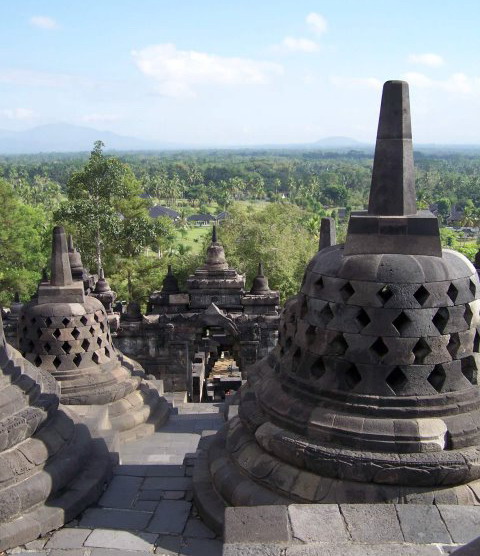
As a recognized religion in the country, many Hindu and Buddhist heritage yangs enantiasa diziarahi people. The existence of the Prambanan Temple and the temple Brorobudur not just a place of pilgrimage for the Hindu - Buddhist, but has become an international tourist attraction. Even so the existence of pagoda. Building a culture that is this Thionghoa cultural heritage, other than as a place of prayer congregation Confucianism, also excellent emnajdi for religious tourism. Here are some religious attractions Hinduism, Buddhism and Confucianism.

Prambanan
This is the largest Hindu temple complex in Indonesia. Prambanan is located in the village whose territory is divided between the district of Sleman (Yogyakarta) and Klaten (Central Java about 20 km east of Yogyakarta temple that was built around 850 AD This is the Sanjaya Dynasty relics. With the main buildings as high as 47 meters, Prambanan is the largest Hindu temple in Southeast Asia. Since 1991 the temple has become a world heritage site protected by UNESCO, which means that the complex is shielded and has a special status, for example in war situations.


This temple complex consists of 8 major temple or temples and more than 250 small temples. Three main temples called Trisakti and dedicated to Sang Hyang Trimurti: Shiva the Destroyer Batara, Batara Vishnu the Preserver and Batara Brahma the Creator.

Candi Borobudur
Temple is located in Magelang District, Central Java, this is one of the wonders of the world. Unlike the temples in Bali is mostly Hindu cultural heritage, Borobudur is the largest Buddhist cultural heritage in the world. According to Prof Dr JG Casparis, a ninth-century inscription reveals the genealogy of the three Sailendra king, a king Indra, his son, Samaratungga, and then daughter Samaratungga, namely Pramodawardhani.


In the reign of King Samaratungga, start construction of the temple named Bhumisam Bharabudhara, which can be interpreted as "Hill Improvement Virtue", that is, after over ten levels of Bodhisattva. Having completed for about 150 years, Borobudur is a magnificent pilgrimage center for Buddhists until around the year 930 AD

Grandeur, majesty, beauty, and unique architecture of Borobudur Temple wrapped with important values of the religion, culture and history has been the focus of attention Buddhists. Both in Indonesia and abroad, and tourists in general to come visit.

Sam Po Kong temple
Building stones of Sam Po Kong is a petilasan, the former stops and the first landing of an admiral named Zheng He of China / Cheng Ho or more commonly known as Sam Po Tay Djien. The building is located in Simongan area, southwest of Semarang City is known for its stone building is a huge Batu Caves are situated on a hill of stone.


Now the place is used as the location of the warning and a place of worship or prayer and a place for pilgrimage. For this purpose, in a cave of stone was placed an altar, and statues of Sam Po Tay Djien. They adore Sam Po Kong as a person worthy of respect and uphold and sought his blessing.

Tang Jin De Yuan

From dozens of temples in Jakarta, there are several famous old temples. One of them is the Temple of Jin De Yuan (Kim Tek le) in the area of Old Chinatown Glodok, West Jakarta. This temple was formerly under the management of Guan Gong or the Board of Officers Tionghoa "Batavia, while still berjayanya these institutions, along with Da Bo Gong Temple - Ancol, Tanjung temple (already destroyed) and the Temple of Wan Ji Sie (Kiap Wan Si) in Jalan Lautze . The four temples are known as the "Four Great Temple".


In his book HistoricalSitesofJakarta (1989), Adolf Heuken stated that the "Historical Notes on Brick Tionghoa ~ he" was recorded in about 1 650 Tionghoa Luitenant Xun Guo Guan (Hoen Kwee) established a temple in honor of Guan Yin (Guan Yin) in Glodok. At first, this temple is called Ting Guan Yin (Guan Yin Teng), or literally, Guan Yin Pavilion.

In its development nearly a century later the temple was destroyed and burned in the incident Angke Tragedy Massacre in 1740. In the year 1 755 a renaming Tionghoa Captain who had destroyed the temple and then restored again with the name of Jin De Yuan (Kim Tek le) - Temple of the Golden Virtues ".

Da Bo Gong temple

Although the same age as Jin De Yuan temple in Glodok, Da Bo Gong Temple (Temple of Ancol) has a different background. This temple Tionghoa language called Da Bo Gong Miao or Da Bo Gong temple. From Da Bo Gong or Toa Pe Kong (Hokkien pronunciation) appears Indonesian term for deity statues Indonesians, namely `topekong '.

There's something amazing about this temple. Tionghoa people should not bring pork into the temple courtyard. Why? This is linked with his trademark: Ancol temple is a shrine double. In ancient times, people Tionghoa and Muslims both worship the same place. So this place is a temple and at the same Tionghoa shrine for Muslims. Doubles as a shrine temple Ancol, also found in Semarang (Stone Building) and Palembang (Island Drought).

Source: SuaraMerdeka


Twitter Delicious Facebook Digg Stumbleupon Favorites More

 
Design by Free WordPress Themes | Bloggerized by Lasantha - Premium Blogger Themes | 100 Web Hosting